
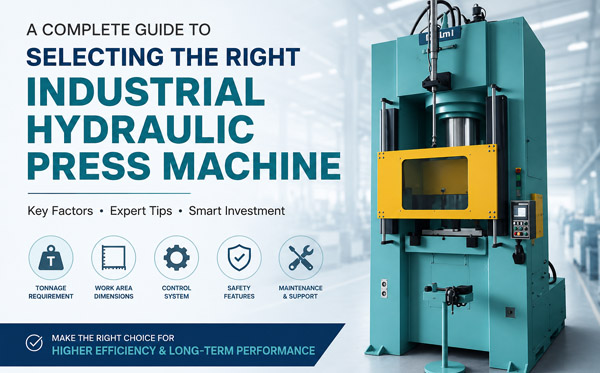
A Complete Guide to Selecting the Right Industrial Hydraulic Press MachineUpdate:2026-06-16 Hits:169
Make the right choice for your production – from tonnage to tooling, safety to service life.
Choosing an industrial hydraulic press is one of the most consequential decisions for any manufacturing operation. The right press boosts throughput, reduces downtime, and improves part quality. The wrong one? It eats into your budget and creates bottlenecks. This guide walks you through every critical factor — so you can select a press that fits your application perfectly.
1. Know Your Press Types
Hydraulic presses come in several architectures. Each serves a different purpose. Identify which one matches your production environment:
Single-column (C‑frame)
Open on three sides, excellent for small‑to‑medium parts, punching, bending, and straightening. Easy access and compact footprint.
Four‑column (H‑frame)
Rigid, high‑tonnage workhorse. Ideal for deep drawing, forging, and compression molding. Superior alignment and stability for demanding applications.
Hot / Forging Press
Designed for high‑temperature forming. Built with heat shields, robust cooling, and heavy‑duty cylinders to handle extreme stress.
Stamping & Punching
High‑speed, short‑stroke presses for blanking, piercing, and coining. Often paired with servo‑hydraulic control for precision and speed.
2. Tonnage & Force – Don’t Underestimate
Calculate total forming force required: material yield strength × surface area × safety factor (1.2–1.5). Always choose a press with 15–25% more capacity than your peak calculated load. This extends cylinder life and handles material variations.
3. Speed, Stroke & Cycle Time
Every application has a rhythm. Match the press's approach speed, pressing speed, and return speed to your cycle requirements. For high‑volume production, prioritize fast approach and return with a controlled pressing phase.
- Short stroke, high speed: stamping, blanking.
- Long stroke, slower speed: deep drawing, hydroforming.
- Variable speed: use servo‑hydraulic or proportional valves for flexibility.
4. Control Systems – From Manual to Smart
Modern hydraulic presses offer PLC‑based controls, touchscreen interfaces, and even IoT connectivity. Decide how much automation and data visibility you need:
- Manual / Relay logic: simple, low‑cost, but limited.
- PLC with HMI: programmable cycles, pressure monitoring, and diagnostics.
- Servo‑hydraulic: energy‑efficient, ultra‑precise position and speed control.
If you plan to integrate with MES or track OEE, opt for a press with open communication protocols (Ethernet/IP, Profinet, OPC UA).
5. Safety & Ergonomic Features
Never compromise on safety. Look for:
- Two‑hand anti‑tie‑down controls
- Light curtains or area scanners
- Emergency stops with redundant circuits
- Overload protection and pressure relief valves
- Low‑noise pump and sound enclosures
Ergonomics matter too: adjustable work heights, low‑force controls, and automatic part ejection reduce operator fatigue and boost productivity.
6. Total Cost of Ownership (TCO)
Price tag is only the beginning. Factor in:
| Cost element | What to evaluate |
|---|---|
| Initial purchase | Machine cost + tooling + installation |
| Energy consumption | Motor efficiency, pump type (fixed vs variable displacement) |
| Maintenance | Seal replacement, oil changes, cylinder rebuilds |
| Downtime | Mean time between failures (MTBF), spare parts availability |
| Resale value | Build quality & brand reputation |
Choose a manufacturer that provides transparent service contracts and local technical support.
7. Your Pre‑Purchase Checklist
Before signing the order, verify these points with your supplier:
- Detailed force–stroke diagram at working pressure
- Frame deflection under full load (should be <0.5 mm/m)
- Noise levels at max speed (below 85 dBA recommended)
- Oil filtration system (10 µm or better)
- Warranty terms and spare parts lead time
- On‑site commissioning and training included
8. Choosing a Reliable Manufacturer
Look for proven engineering, global compliance (CE, UL, ISO), and customer references. Established brands often offer better documentation and after‑sales support. Don’t hesitate to request a factory acceptance test (FAT) or a demo with your actual tooling.
9. Real‑World Application Fit
Automotive stamping
High‑speed H‑frame with servo pump, quick die change, and light curtains. Capacity: 500–2000 tons.
Aerospace forging
Heavy‑duty four‑column with high tonnage (3000+ tons), slow speed, and precise position control.
Electronics punching
Compact C‑frame with precision ram guide, short stroke, and low‑noise package. Capacity: 20–150 tons.
Lab / R&D
Benchtop or mini‑press with instrumentation for material testing, often with load cells and displacement sensors.
10. Final Words – The Right Fit Matters
Selecting an industrial hydraulic press is not just about force; it's about process capability, reliability, and operator safety. A hydraulic press machine that fits your current needs but also scales with future demands is a strategic investment. Take your time, consult with multiple suppliers, and always request a performance guarantee.
Need a custom recommendation?
Share your application details – our engineers can help you match the perfect press configuration, tonnage, and control package for your production line.
Talk to an expert →News
- Hydraulic Press Machines Engineered for Precision & Heavy-Duty Manufacturing2026-09-28
- Hydraulic Press Manufacturer: Precision-Engineered, Automated Solutions2026-09-21
- Hydraulic Press Industry Trends 2026: Automation, Energy Efficiency & Smart Manufacturing2026-09-14
- Custom vs. Standard Hydraulic Presses: Which Is Right for Your Production?2026-09-09
