
Hydraulic Press Applications Across Modern ManufacturingUpdate:2026-06-22 Hits:176
Hydraulic Press Applications Across Modern Manufacturing
From automotive assembly lines to aerospace engineering, hydraulic presses deliver the force, precision, and reliability that power today’s industrial production.
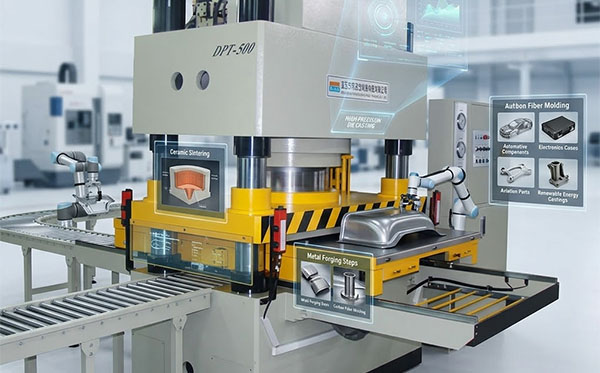
Introduction
Hydraulic press machines have become indispensable across modern manufacturing. Operating on Pascal's principle—which states that pressure applied to a confined fluid is transmitted equally in all directions—these machines convert hydraulic fluid pressure into mechanical force capable of exceeding 10,000 tons. This enables manufacturers to shape, form, cut, and assemble materials with exceptional control and consistency.
The global hydraulic press machine market was valued at approximately $15 billion in 2024 and is projected to reach $20 billion by 2031, growing at a CAGR of 5.50%. This growth reflects increasing demand across key sectors including automotive, aerospace, electronics, and renewable energy.
Key Applications by Industry
1. Automotive Manufacturing
The automotive sector is the largest consumer of hydraulic press technology, utilizing these machines for a broad range of applications:
- Body Panel Stamping: Forming doors, hoods, fenders, and roof panels with consistent precision across millions of units.
- Deep Drawing: Producing hollow components such as fuel tanks, oil pans, and exhaust system parts.
- Forging critical structural parts, including crankshafts, connecting rods, and suspension components that require exceptional strength and durability.
- Braking System Components: Manufacturing precision parts that demand tight tolerances.
- Powder Compacting: Forming transmission components and other metal powder-based parts.
The rise of electric vehicles (EVs) has expanded applications further, with hydraulic presses now used to shape lithium-ion battery components and produce lightweight structural parts for improved range and efficiency.
2. Aerospace Engineering
In aerospace, safety and performance demand the highest precision. Hydraulic presses play a critical role because they deliver uniform force throughout the entire stroke, unlike mechanical presses that lose force at certain positions.
Key applications include:
- Forming engine components and turbine blades
- Shaping structural airframe parts
- Manufacturing landing gear components
- Rubber pad forming for complex sheet metal parts
- Producing high-strength, lightweight components for commercial and military aircraft
The controlled, steady pressure of hydraulic presses ensures tight tolerances and consistent material properties, both essential for aerospace certification requirements.
3. Electronics and Electrical Manufacturing
The electrical and electronics industry relies on hydraulic presses for producing components that require fine surface detailing and dimensional accuracy:
- Coining—a precision embossing technique used for electrical contacts and terminals
- Embossing and stamping for appliance control panels and device housings
- Punching precision metal parts for circuit protection devices and connectors
- Molding operations for plastic electrical components
4. Ceramics and Powder Metallurgy
Hydraulic presses excel at powder compacting, a process where powdered materials are compressed into solid forms with precise density and shape:
- Manufacturing ceramic tiles, insulators, and sanitary ware
- Producing abrasive wheels and cutting tools
- Forming powder metal components for automotive and industrial applications
- Replacing traditional kiln-based processes with room-temperature operations in some ceramics applications
5. Recycling and Waste Management
While less glamorous than high-precision manufacturing, hydraulic presses are critical for environmental sustainability:
- Scrap baling: Compacting metal scraps, cardboard, and plastics for efficient transport and recycling
- Car crushing: Reducing end-of-life vehicles to manageable sizes
- Processing industrial waste streams
6. Other Key Applications
| Process | Description | Common Products |
|---|---|---|
| Blanking | Cutting flat shapes from sheet metal | Gaskets, washers, enclosures |
| Clinching | Joining metal sheets without welding or fasteners | HVAC components, automotive panels |
| Laminating | Bonding layers under pressure and heat | Composite panels, circuit boards |
| Stretch Forming | Creating complex curves from sheet metal | Aircraft skins, architectural panels |
| Compression Molding | Shaping rubber, plastic, and composite materials | Seals, gaskets, insulation parts |
Key Advantages Driving Adoption
Hydraulic presses offer several distinct benefits over traditional mechanical systems:
Unlike mechanical presses that achieve maximum force only near the bottom of the stroke, hydraulic presses deliver full tonnage at any point—essential for deep drawing and forging operations. Operators can fine-tune parameters for different materials and processes, making hydraulic presses suitable for both delicate operations and heavy-duty tasks. Controlled, smooth force application extends die and punch life, reducing replacement costs.
Modern servo-hydraulic and VFD-driven systems deliver high energy efficiency, reducing operational costs and environmental impact.
Technology Trends Shaping the Industry
Intelligent and CNC Hydraulic Presses
The shift from manual to CNC-controlled hydraulic presses represents a major advancement in manufacturing capability. Modern intelligent presses feature:
- IoT connectivity for real-time monitoring
- Predictive maintenance capabilities that reduce downtime
- Big data analytics for process optimization
- Programmable systems for rapid changeovers between jobs
- Servo-driven technology for improved precision and energy efficiency
These advancements enable automated, high-precision manufacturing with minimal human intervention, driving growth in sectors where precision and consistency are non-negotiable.
Sustainability and Energy Efficiency
Manufacturers increasingly seek equipment that supports sustainable operations. Modern hydraulic presses address this through:
- Reduced energy consumption via VFD and servo systems
- Lower oil usage and improved hydraulic fluid management
- Enhanced durability that extends equipment service life
- Integration with broader automated manufacturing ecosystems
Market Outlook
Growth in the hydraulic press machine market is driven by several factors:
- Surging automotive & aerospace demand
- Automated manufacturing adoption
- Growth in fabricated metal consumption
- Technical advantages over traditional equipment
- Energy efficiency with VFDs
Regional Growth: Asia Pacific leads the global market, driven by the presence of key manufacturing industries in China, Japan, and India. North America and Europe remain significant markets due to high adoption of advanced manufacturing technologies.
Market snapshot (2024–2031):
Global market value: $15 billion → $20 billion
CAGR: 5.50%
Key drivers: EV battery component production, aerospace expansion, and Industry 4.0 integration.
Conclusion
Hydraulic press machines have evolved far beyond their origins as simple forming tools. Today, they are intelligent, connected, and energy-efficient systems at the heart of modern manufacturing across virtually every industrial sector.
From the deep drawing of automotive body panels to the precision forging of aerospace components—from powder compacting in ceramics to scrap baling in recycling—hydraulic presses deliver the controlled power that enables reliable, efficient, and consistent production at scale.
As manufacturing continues moving toward Industry 4.0, the integration of IoT, predictive maintenance, and servo-hydraulic technology will only increase the value these machines bring to the shop floor. For manufacturers looking to enhance productivity, quality, and sustainability, hydraulic presses remain an indispensable investment for the future.
News
- Hydraulic Press Machines Engineered for Precision & Heavy-Duty Manufacturing2026-09-28
- Hydraulic Press Manufacturer: Precision-Engineered, Automated Solutions2026-09-21
- Hydraulic Press Industry Trends 2026: Automation, Energy Efficiency & Smart Manufacturing2026-09-14
- Custom vs. Standard Hydraulic Presses: Which Is Right for Your Production?2026-09-09
