
Can A Punching Press Be Used As A Hydraulic Press MachineUpdate:2025-10-16 Hits:279
Can a Punching Press Be Used as a Hydraulic Press Machine?Generally, no. While both are powerful metalworking machines, a punching press is not designed to function as a hydraulic press, and attempting to use it as one can be dangerous and damage the machine.
However, for very specific, low-force applications, the line can sometimes blur. A punching press can be used as a hydraulic press machine to a certain extent, but there are some limitations and differences. Let's break down the key differences to understand why.
The Core Difference: The Nature of the Force
This is the most critical distinction.
● Punching Press: Designed for a sharp, high-speed impact or shear force. Its job is to concentrate immense energy into a tiny area for a split second to pierce or shear through material. Think of it like a professional boxer's jab—fast and sharp.
● Hydraulic Press Machine: Designed for a controlled, sustained squeezing force. It applies pressure gradually and can maintain that pressure over time. Think of it like a powerful, slow-moving vise.
This fundamental difference in how force is applied dictates their design, capabilities, and safe applications.
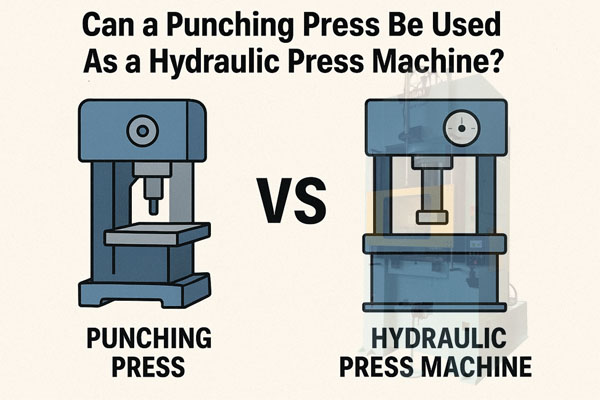
Comparison Table: Punching Press vs Hydraulic Press Machine
| Feature | Punching Press | Hydraulic Press Machine |
| Primary Function | Piercing (punching), blanking, notching in sheet metal. | Forming, bending,coining, molding, deep drawing, assembly/disassembly. |
| Type of Force | High-speed impact/shear. | Slow, controlled,sustained pressure. |
| Stroke Control | Limited. Often a fixed stroke length or a simple up/down cycle. | Highly controllable. Precise control over stroke length, speed, and pressure. |
| Tonnage Application | Tonnage is achieved at a specific point in the stroke (typically the bottom). | Full tonnage can be applied at any point throughout the stroke. |
| Dwell Time | Virtually zero. The ram hits and retracts immediately. | Can hold pressure (dwell) for seconds, minutes, or even hours. |
| Typical Uses | Creating holes in metal sheets, electrical panels, and ductwork. | Metal forming,bearing pressing,powder compacting, laminating,crushing objects. |
| Frame & Construction | Built to withstand sharp, shock loads. | Built to withstand constant, heavy pressure, often with a robust "C" or "H" frame. |
Why You (Almost Always) Shouldn't Use a Punching Press as a Hydraulic Press Machine
1. Lack of Controlled Force & Dwell: A hydraulic press job, like pressing a bearing onto a shaft, requires slow, steady pressure. A punching press delivers a violent "punch." This can easily shatter the bearing, damage the shaft, or cause the components to fly apart.
2. Poor Stroke Control: You cannot precisely control where the ram stops in a punching press. For a pressing operation, you need to stop at the exact moment the bearing is seated. A punching press will simply try to complete its full cycle.
3. Risk of Overloading: While a punching press has a rated tonnage, it's designed for shearing thin materials. Applying its full force to a solid object (like pressing a bushing) can create pressures far exceeding the machine's design limits, potentially damaging the frame, ram, or drive system.
4. Safety Hazards: The high-speed impact can turn metal components into dangerous projectiles. The lack of precise control increases the risk of crushing injuries if the workpiece shifts or breaks unexpectedly.
The Grey Area: Turret Punch Presses with a "Forming" Tool
This is where a partial exception exists, but it's important to understand the limitations.
Modern CNC Turret Punch Presses often have a station called a "forming tool" or "hydraulic form tool." This tool uses a small, self-contained hydraulic cylinder to perform a pressing action.
● How it works: The punch press positions the sheet, and the forming tool uses its own hydraulic power to press a form (like a louver, rib, or dimple) into the metal. The main press itself is not doing the pressing; it's just positioning the sheet.
● Limitation: The force of these forming tools is very low compared to the machine's punching tonnage—often just a few tons. They are only for light forming on sheet metal, not for heavy-duty pressing tasks.
Conclusion
Do not use a standard punching press for tasks intended for a hydraulic press machine.
They are different tools for different jobs. Using them interchangeably is a recipe for:
● Damaged Parts
● Damaged Machinery
● Serious Personal Injury
Always use the right tool for the job:
Need to make holes in sheet metal? Use a Punching Press.
Need to bend, form, press-fit, or apply sustained pressure? Use a Hydraulic Press Machine.
News
- Hydraulic Press Machines Engineered for Precision & Heavy-Duty Manufacturing2026-09-28
- Hydraulic Press Manufacturer: Precision-Engineered, Automated Solutions2026-09-21
- Hydraulic Press Industry Trends 2026: Automation, Energy Efficiency & Smart Manufacturing2026-09-14
- Custom vs. Standard Hydraulic Presses: Which Is Right for Your Production?2026-09-09
