
How Old Hydraulic Press to Meet Modern Production DemandsUpdate:2025-10-25 Hits:309
Can That Old Hydraulic Press Keep Up? Modernizing for Today's Production DemandsIn an era of smart factories and high-speed automation, it's easy to overlook the classic workhorse of the workshop: the traditional hydraulic press. Many of these machines, built decades ago with robust cast iron and simple hydraulics, are still mechanically sound. The question for modern manufacturers isn't necessarily if they can be used, but how they can be upgraded to meet the stringent demands of speed, precision, data, and safety required today.
The answer is a resounding yes—with the right upgrades, an old hydraulic press can be transformed from a reliable brute into a sophisticated, efficient, and connected production asset.
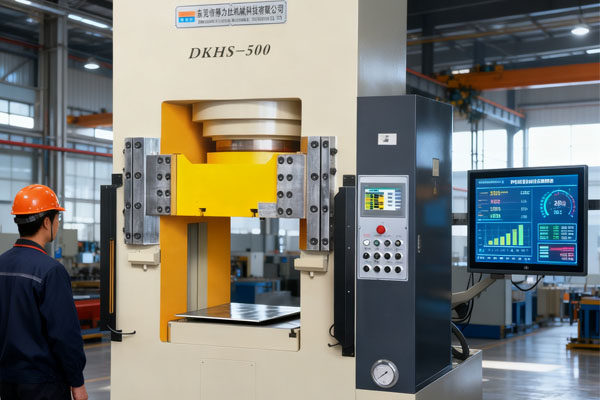
The Modernization Toolkit: Key Upgrades for an Old Hydraulic Press
The path to modernization involves retrofitting the press with new technology. Here are the most impactful upgrades:
1. Programmable Logic Controller (PLC) and Human-Machine Interface (HMI)
This is the brain of the operation.
● PLC: Replaces old relay logic, allowing for complex, automated sequences. You can program multiple recipes for different parts, control press speed and force profiles precisely, and integrate with other machines.
● HMI (Touchscreen): Provides an intuitive interface for operators to select jobs, set parameters, and view real-time machine status. It eliminates guesswork and manual adjustments.
2. Precision Proportional Valves
These electronically controlled valves are the key to finesse.
● They allow for precise control of hydraulic flow (speed) and pressure (force). This enables sophisticated press cycles like "fast approach > slow pressing > high-force dwell > fast return," which is essential for quality in processes like molding, forming, and bonding.
3. Advanced Sensor Technology
Sensors turn the "black box" into a transparent, data-rich process.
● Pressure Transducers: Measure the actual force (tonnage) being applied to the part. This is critical for quality control—you can now detect if a part is out of spec or if a fault occurs.
● Position Transducers (Linear Encoders): Precisely measure the ram position. This allows for control based on position (e.g., stop pressing at a specific depth) rather than just pressure or time.
● Temperature Sensors: Monitor hydraulic fluid or tooling temperature for sensitive processes.
4. Data Acquisition and Connectivity (IIoT)
This is where a classic press joins the Industry 4.0 revolution.
● The PLC can be networked to feed data to a central system (SCADA or MES).
● Key Data Points: Cycle count, cycle time, peak pressure/force, production rates, and fault logs.
● Benefits: Enables predictive maintenance (alerting you before a failure), provides full traceability for every part produced, and highlights bottlenecks for process improvement.
5. Energy Efficiency Upgrades
● Variable Frequency Drive (VFD) on the Pump Motor: Instead of running the main motor at a constant speed, a VFD allows it to speed up or slow down based on demand. This can reduce energy consumption by 30-50% and reduce heat and noise.
● Modern Hydraulic Pumps: Upgrading to a high-efficiency piston pump or a variable-displacement pump can also yield significant energy savings over an old, fixed-displacement vane pump.
6. Safety System Retrofit
This is non-negotiable.
● Install modern safety light curtains, two-hand control stations, or physical guarding that meets current standards (e.g., OSHA, CE, ISO 13849).
● The PLC can be used to implement a safety relay circuit to ensure the press cannot operate if a guard door is open or the light curtain is breached.
Benefits vs. Cost: The Business Case for Modernization
| Benefit | Description |
| Increased Productivity | Faster, more consistent cycles and reduced manual intervention boost output. |
| Superior Quality & Repeatability | Precise control and monitoring ensure every part is made exactly the same. |
| Reduced Scrap & Rework | Real-time force and position monitoring catches errors immediately. |
| Enhanced Data & Traceability | Digital records for every part produced, essential for automotive, aerospace, and medical industries. |
| Improved Safety | A safer work environment protects employees and reduces liability. |
| Lower Operating Costs | Energy savings and reduced downtime from predictive maintenance. |
| Capital Cost Savings | Retrofitting is often 20-50% of the cost of a new, equivalent-capacity press. |
| Sustainability | Extending the life of a heavy-duty machine is a "green" manufacturing choice. |
Is Modernization Right for You? A Simple Checklist
Consider retrofitting your old hydraulic press if:
● The structural frame, cylinder, and platens are still in good mechanical condition.
● Your production requires higher precision, speed, or data than the press currently provides.
● The cost of a new press with similar features is prohibitive.
● You need to integrate the press into a automated cell or line.
Safety compliance is a primary concern.
Consider a new press if:
● The frame is cracked, the cylinder is badly worn, or the cost of mechanical repairs is high.
● You require a completely new technology (e.g., much higher speed servo-presses).
● The footprint or basic design of the old press is unsuitable for your new production layout.
Conclusion
An old hydraulic press should not be seen as obsolete, but as a platform with immense potential. By strategically investing in a retrofit—focusing on a PLC, precision valves, sensors, and safety—you can bridge the gap between its brute strength and the intelligence of modern manufacturing. This approach delivers a high-performance, data-capable machine that rivals new equipment, all while maximizing your existing investment and keeping a piece of industrial history productively at work.
News
- Hydraulic Press Machines Engineered for Precision & Heavy-Duty Manufacturing2026-09-28
- Hydraulic Press Manufacturer: Precision-Engineered, Automated Solutions2026-09-21
- Hydraulic Press Industry Trends 2026: Automation, Energy Efficiency & Smart Manufacturing2026-09-14
- Custom vs. Standard Hydraulic Presses: Which Is Right for Your Production?2026-09-09
