
Hydraulic Press Tonnage Calculator & Selection GuideUpdate:2026-05-15 Hits:325
IntroductionFor nearly three decades, manufacturers across the automotive, appliance, aerospace, and energy sectors have turned to Goodsjack / Delishi Hydraulic Machinery for one simple reason: we help them get the tonnage right.
Why does tonnage matter so much? Because a hydraulic press that is underpowered will fail to form your parts — stalling production, straining the frame, and creating safety hazards. A press that is grossly overpowered, on the other hand, wastes energy, raises capital costs, and wears down tooling unnecessarily.
The sweet spot is precise, intelligent sizing. And that’s exactly where our servo hydraulic press technology excels.
Having designed, built, and delivered over 1,000 units annually from our Dongguan and Huizhou Intelligent Manufacturing Industrial Park — with capabilities spanning 5 ton to 10,000 tons — we have seen nearly every tonnage mistake imaginable. This guide will help you avoid those pitfalls.
Why Correct Tonnage Matters More Than Ever
AI-driven factories and Industry 4.0 production lines demand hydraulic press machines that are efficient, consistent, and intelligent. An incorrectly specified press — whether too small or too large — undermines all three goals.
● Too little tonnage: Leads to incomplete stamping, shallow draws, damaged tooling, and jammed production cycles. Continuous operation at overload can also reduce the press frame's lifespan and create unsafe conditions.
● Too much tonnage: Increases initial investment, occupies more floor space, and consumes more electricity per cycle. Energy inefficiency is a major drawback of conventional oversized hydraulic systems.
● Right tonnage with servo control: Delivers optimal forming results with minimal energy waste, extended tool life, and consistent repeatability — shift after shift.
The goal is not just to “buy a press.” The goal is to install a forming solution that runs profitably for years.
How to Calculate Required Press Tonnage (Step by Step)
Let’s move from theory to practice. While every application is unique, the core calculation follows a proven engineering logic.
The Basic Hydraulic Press Tonnage Formula
For most stamping, blanking, and forming operations, you can estimate required tonnage using:
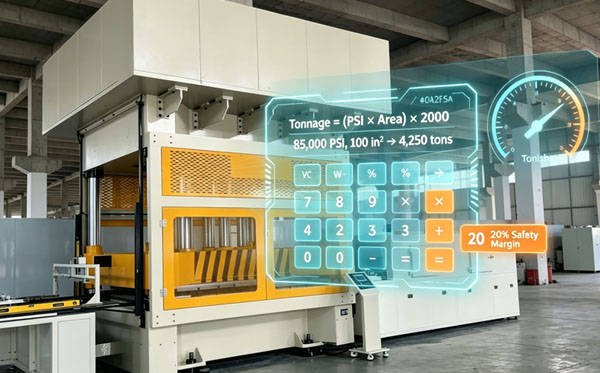
Required Tonnage = Material Strength (PSI) × Workpiece Area (in²) ÷ 2,000
Where:
● Material Strength = tensile or shear strength of your workpiece (provided by your material supplier)
● Workpiece Area = total surface area that the press will form
● Division by 2,000 = converts pounds to tons
Step-by-Step Example
Let’s say you’re forming a 10” × 10” stainless steel part with a tensile strength of 85,000 PSI.
1. Workpiece Area: 10 in × 10 in = 100 square inches
2. Multiply: 85,000 PSI × 100 in² = 8,500,000 pounds
3. Convert to tons: 8,500,000 ÷ 2,000 = 4,250 tons
That’s your raw requirement.
Adding the Safety Margin
Never specify a press at the exact calculated tonnage. You need a buffer — typically 15% to 30% — to account for material inconsistencies, tool wear, die clearance variations, and future production changes.
If your calculation came to 4,250 tons, adding a 20% safety margin brings you to 5,100 tons. That’s the practical target.
Alternative Method: For Punching Operations
For punching or blanking, the formula shifts to focus on cut perimeter × material thickness:
Tonnage = Perimeter of Cut (in) × Material Thickness (in) × Shear Strength (PSI) ÷ 2,000
This method is particularly useful for precision blanking of automotive or electronics components where cut geometry drives force demand.
Matching Tonnage to Your Application
Different forming processes demand different force characteristics. Here is a quick reference based on decades of hands-on experience:
| Application | Typical Tonnage Range | Notes |
| Precision stamping (small parts) | 10 – 200 tons | Electronic contacts, battery terminals |
| Deep drawing (kitchenware) | 100 – 800 tons | Requires smooth drawing control to avoid cracking |
| Cold forging (fasteners, gears) | 200 – 1,200 tons | High-impact loads; extra frame rigidity needed |
| Hot forging | 500 – 3,000 tons | Force must remain consistent at elevated temperatures |
| Sheet metal stamping (automotive) | 200 – 1,000 tons | Large dies require uniform pressure distribution |
| Heavy-duty forming (appliance panels) | 1,000 – 10,000 tons | Multi-station lines require synchronised tonnage |
Why Choose a Servo Hydraulic Press for Your Tonnage Needs
Once you have determined your tonnage, the next question is: conventional hydraulic or servo hydraulic?
As a pioneer in servo press technology since 1997, we have watched the industry shift decisively toward servo-driven systems. Here is why:
1. Energy Savings of 50–70%
Traditional hydraulic presses run motors continuously — even when not forming — consuming power during idle cycles. Our servo systems draw power only when moving or exerting force, cutting total energy consumption by 50–70% and eliminating wasteful heat generation.
2. Sub‑Millimetre Precision
Our servo intelligent patented control system maintains repeated positioning accuracy of ±0.03mm and pressure error of ±1%. This level of precision cannot be achieved with conventional valve‑controlled systems — it transforms scrap rates and part consistency.
3. Quiet, Cool, and Reliable
Reduced heat generation means less demand for hydraulic oil cooling, lower ambient temperatures on the shop floor, and longer fluid life. Fewer mechanical wearing parts also translates to reduced maintenance requirements.
4. Programmable Cycle Profiles
Unlike fixed-stroke conventional presses, servo systems allow you to fully program speed, position, and pressure across the stroke. This flexibility is indispensable when the same press must handle deep drawing, coining, punching and embossing within a single shift.
Beyond Tonnage: Other Critical Selection Parameters
Tonnage is only one dimension of a properly specified hydraulic press. Here are additional factors you must evaluate before signing an order.
Press Type: C-Frame vs. Four-Column vs. Frame Guide
C-Frame (open-frame) presses — Offer excellent accessibility from three sides, ideal for smaller parts and automation integration. Goodsjack servo C-frame models are widely used in electronics assembly and precision stamping.
Four-Column presses — Deliver balanced load distribution and superior rigidity, essential for deep drawing, cold forging, and large‑area stamping.
Frame Guide / Eight‑Side Guide presses — Provide maximum stiffness for high‑tonnage applications where deflection cannot be tolerated.
Daylights, Stroke, and Bed Size
Your press must physically accommodate your dies and parts. Measure the daylight opening (distance between the bed and the ram at full stroke) and the bed dimensions. If you are retrofitting into an automated line, pay special attention to shut height and clearance for tool changers.
Speed Requirements
Different materials require different forming speeds. Servo presses give you full speed control — slow approach for alignment, high-speed pressing where permitted, and slow release to avoid spring‑back. The production cycle on our 1,900-ton five-sequence line reaches 7 pieces per minute, with a one‑button mold change of under four minutes.
Automation and Connectivity
Modern servo hydraulic presses integrate seamlessly with robotic arms, conveyors, and MES systems. Our touch‑screen PLC (Siemens brand) allows real-time monitoring and diagnostics — pressure, stroke, dwell time, and cycle counts are visible at a glance.
Safety and Compliance
Every servo hydraulic press from Delishi is equipped with infrared safety gratings, ISO 9001:2015 certified, and CE compliant. We also offer custom guarding and interlock systems per local regulations.
Common Tonnage Mistakes — and How to Avoid Them
Over 28 years of serving customers worldwide, we have encountered the same missteps repeatedly. Here are the three most common:
Mistake 1: Ignoring the safety factor. Buyers calculate tonnage precisely and order that exact capacity — only to find that slightly thicker material batches stall the press six months later. Always add a 15–30% safety margin.
Mistake 2: Future‑proofing without planning. The opposite error is buying a press that is vastly oversized “just in case.” The result is higher purchase cost, higher energy bills, and slower cycles. Be honest about your projected volume and part mix. If your needs change dramatically, consider a second, appropriately sized press.
Mistake 3: Overlooking material strength variations. Aluminum, brass, stainless steel and high‑strength alloys all behave differently. Consult a material data sheet for tensile strength (PSI or MPa) and base your calculation on the hardest material you will form, not the average.
Real‑World Success: From Kitchenware to Bipolar Plates
Our tonnage selection expertise is not theoretical — it has been validated across industries.
● Kitchenware manufacturing: 300–800 ton deep drawing presses with servo‑saving systems, delivering 50–70% energy reduction and ±0.03mm repeatability.
● Automotive stamping: 1,900-ton five-sequence fully automatic lines producing dishwasher and washing machine boxes at 7 parts/minute.
● Fuel cell bipolar plate forming: High‑precision servo hydraulic presses with ±0.5% pressure error tolerance.
● Battery component forming: Custom presses for full battery enclosures, battery trays, and electrodes — a field where tonnage uniformity across large dies is critical.
Every one of these applications began with the same step: a careful tonnage calculation followed by a frank discussion about production goals. That is what we offer every customer — not a catalog, but a engineering partnership.
Your Hydraulic Press Selection Checklist
Before contacting us, take five minutes to answer these questions. The answers will dramatically shorten your selection process.
● What material(s) will you be forming? (Type, thickness, tensile strength)
● What is the die contact area (in² or cm²)?
● What is the forming operation? (Stamping / blanking / deep drawing / forging / coining / embossing)
● What is your required daylight opening and stroke length?
● What is your cycle target (parts per minute / per hour)?
● Will this press be integrated into an automated line (robots, conveyors, MES)?
● What is your safety and certification requirement (CE, ISO, local standards)?
● Do you need rapid tool change capability?
With those answers in hand, we can propose a servo hydraulic press solution sized precisely to your operation — not 50 tons too light, not 200 tons too heavy.
Ready to Stop Guessing and Start Forming?
At Goodsjack / Delishi Hydraulic Machinery, we have spent nearly three decades manufacturing servo‑controlled hydraulic presses for customers around the world — from small precision stamping shops to Fortune 500 tier‑one suppliers.
We manufacture in‑house, from frame cutting to final assembly, allowing us to control quality, lead times, and cost. Our capacity ranges from 5 tons to 10,000 tons, covering nearly every industrial forming application.
Contact our engineering team to discuss your tonnage requirements, submit your part drawings for a force analysis, or schedule a factory tour at our Huizhou Intelligent Manufacturing Industrial Park.
News
- Hydraulic Press Machines Engineered for Precision & Heavy-Duty Manufacturing2026-09-28
- Hydraulic Press Manufacturer: Precision-Engineered, Automated Solutions2026-09-21
- Hydraulic Press Industry Trends 2026: Automation, Energy Efficiency & Smart Manufacturing2026-09-14
- Custom vs. Standard Hydraulic Presses: Which Is Right for Your Production?2026-09-09
