
Automated Hydraulic Press Solutions for Precision Optical Device ManufacturingUpdate:2026-07-27 Hits:98
Automated Hydraulic Press Solutions for Precision Optical Device Manufacturing
The manufacturing of modern optical devices—from fiber optic connectors and transceivers to precision glass lenses—demands levels of precision, repeatability, and cleanliness that traditional fabrication methods often cannot achieve. Automated hydraulic press solutions have emerged as a critical technology in this space, offering the controlled force and micron-level accuracy necessary for high-yield, high-quality optical component production.
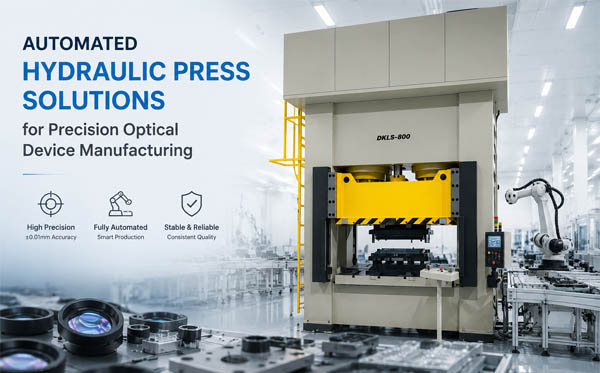
Key Insight: In optical device manufacturing, the role of the hydraulic press has evolved from a heavy-duty forming tool to a precision positioning and force application system, often achieving pressure control accuracies within ±1% and positioning repeatability down to the micrometer scale.
Why Hydraulic Pressing for Optical Components?
The unique demands of optical fabrication—where surface roughness, dimensional tolerance, and material integrity are paramount—make automated hydraulic pressing an ideal solution for several key applications.
1. Precision Glass Molding
One of the most prominent applications is in the precision molding of optical glass elements. This process requires extremely precise control over the press shaft's position and the pressure applied to the molten glass preform. A hydraulic press apparatus, equipped with advanced flow control valves and real-time position feedback, can precisely control the timing and force of each pressing step, ensuring the final optical element meets exacting geometric and surface quality specifications. This level of automation is critical for manufacturing lenses used in cameras, medical devices, and telecommunications equipment.
2. Fiber Optic Plate Fabrication
Fiber optic plates (FOPs), used in image intensifiers and other optical systems, demand exceptional uniformity. The development of automated vacuum melt presses for FOP fabrication demonstrates how hydraulic proportional feedback systems and sensor technology have replaced conventional, less accurate presses. These automated systems provide remarkable control over critical process parameters, including temperature (±0.1°C), vacuum (±2 Pa), and pressure (±1%), significantly improving product consistency and reproducibility.
3. Specialty Optics: Metal Monocapillary Fabrication
For advanced synchrotron radiation and X-ray applications, metal monocapillary optics require extremely straight, smooth internal bores. A novel hydraulic pressing method imprints a precisely tapered wire pattern into soft metal plates. The hydraulic press provides the symmetrical, highly controlled force needed to create capillaries with 5–10 μm diameter beams and high flux-density gains [3]. This application highlights the versatility of hydraulic systems in producing micro-scale optical structures with exacting geometries.
Key Advantages of Automation in Hydraulic Press Systems
Integrating advanced automation and control systems into hydraulic presses provides significant benefits for optical manufacturing.
- Simultaneous Force and Position Control: Advanced presses can control both the position of the press plates and the force exerted, with opto-electronic feedback (e.g., Heidenhain encoders) ensuring repeatable positioning. This dual capability is essential for processes where both the depth and pressure of the pressing stroke must be tightly managed.
- High Repeatability and Yield: Automation eliminates the variability inherent in manual processes. By precisely controlling pressure, temperature, and time, manufacturers can achieve 6σ (six sigma) quality levels, targeting geometric tolerances below 1000nm for critical components.
- Reduced Human Error: Automated systems drastically reduce light loss and defects caused by inconsistent manual operations, such as uneven solder application during packaging, by ensuring simultaneous and balanced actions.
Integration into Optical Assembly Processes
Beyond component fabrication, automated hydraulic technology plays a vital role in the assembly and packaging of optical devices, including complex optical transceivers for high-speed data communication.
- Automated Optical Packaging: Hydraulic presses integrated with focusing platforms and multi-axis feed sets are used to automate the precise alignment and soldering of optical components. Three-point simultaneous solder feeding systems, for example, are controlled to minimize thermal shift and ensure an airtight seal—a critical factor for long-term reliability.
- Cable and Fiber Assembly: In manufacturing processes like fiber wrapping for high-voltage cables, hydraulic lifting arms and pressing devices are used to clamp and compress optical fibers against cable insulation securely. This ensures consistent contact and prevents fiber strain due to cable bending.
- Sealing and Connector Assembly: Hydraulic pressing techniques are also employed to apply sealants and secure components, such as ferrules and connectors, preventing moisture ingress and protecting delicate optical interfaces.
Industry Trend: The push toward higher data rates (e.g., 800G, 1.6T transceivers) and advanced autonomous driving sensors is driving demand for manufacturing solutions that can deliver both nanometer-scale precision and high throughput. Automated hydraulic press systems, with their ability to provide stable, programmable force and position control, are increasingly a cornerstone of these advanced production lines.
The Future: Smart Hydraulic Systems for Optical Manufacturing
As Industry 4.0 principles take hold, hydraulic press systems are becoming smarter. Features like real-time data acquisition, closed-loop feedback, and integration with digital manufacturing systems enable unparalleled process monitoring and control. This digitalization allows manufacturers to not only produce components with higher precision but also to predict maintenance needs, reduce downtime, and continuously optimize their production processes.
For manufacturers of optical devices, partnering with a supplier that understands both the capabilities of advanced hydraulic technology and the stringent demands of optical manufacturing is essential. The integration of world-class hydraulic systems with intelligent automation is no longer a luxury but a necessity for achieving the precision, consistency, and scalability required to succeed in today's competitive market.
News
- Hydraulic Press Machines Engineered for Precision & Heavy-Duty Manufacturing2026-09-28
- Hydraulic Press Manufacturer: Precision-Engineered, Automated Solutions2026-09-21
- Hydraulic Press Industry Trends 2026: Automation, Energy Efficiency & Smart Manufacturing2026-09-14
- Custom vs. Standard Hydraulic Presses: Which Is Right for Your Production?2026-09-09
